A design system gives Agent the knowledge it needs to build on-brand UI across everything your organization creates on Replit - web apps, mobile apps, slides, and other artifacts. By setting up your component library, design tokens, brand assets, and usage rules within the standard Replit pnpm monorepo, Agent applies your visual language from the first prompt.
Design systems are available exclusively on the Enterprise plan. Only org admins can configure and manage design systems.

Why set up a design system

Without a design system, every builder needs to manually explain your component library, color tokens, and layout conventions to Agent. Setting up a design system solves this by:
  • Encoding your visual standards: Agent uses your exact components, colors, and spacing - not generic defaults
  • Ensuring consistency: Every app follows the same design language
  • Reducing onboarding time: New builders produce on-brand results immediately
  • Capturing tribal knowledge: Design decisions and component usage patterns that live in your team’s heads get documented for Agent

What you will need

  • Frontend code component library either as a tarfile or as a Figma component library
  • Font assets and icons used in your design system
  • Any AI documentation of your design system (MCP, Agent Skills)

What you can configure

Setting up a design system involves three parts:
  1. Custom instructions. Your custom_instruction/instructions.md file gives Agent the high-level rules that apply to every project: which component library to use, which design tokens to reference, and which patterns to follow. Agent always has this file in context.
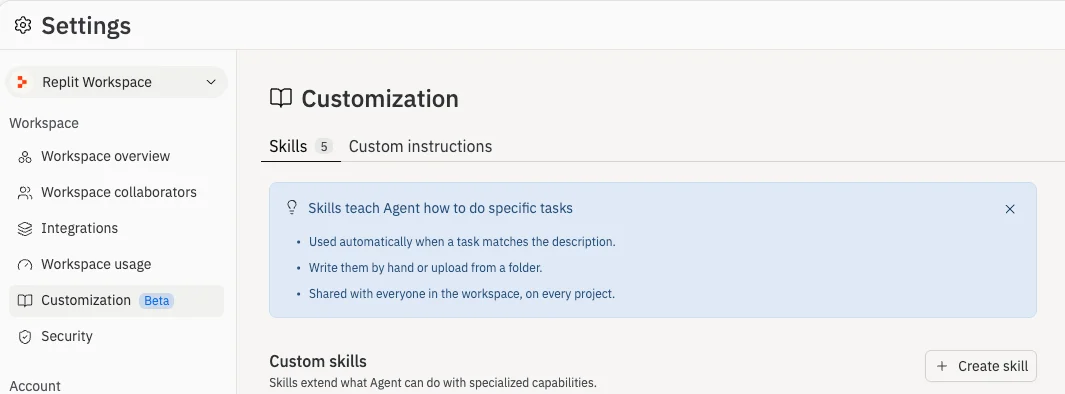
  2. Skills. Skills in .agents/skills/ provide detailed reference material that Agent loads on demand. Use them for component API documentation, theming guides, layout pattern libraries, and other deep reference content that would be too large for the main instructions file.
  3. Design and brand assets. Place your logos, icons, fonts, and other brand assets in a dedicated folder (for example, src/assets/brand/). Configure a Vite path alias so Agent and builders can reference them with clean imports like @brand/logo.svg instead of fragile relative paths. This keeps asset references consistent across the entire project.

Step-by-step guide

This guide walks you through setting up a design system end to end. Start with whichever flow matches your starting point - a Figma component library or an existing code component library - then proceed to the final step to create the design system skill.

Starting from Figma

If your components live in Figma, start by copying one of the starter component library apps: Once you have copied the project:
  1. Import your design tokens. Bring in your colors, fonts, and icons so the component library reflects your brand.
  2. Add components to the registry. Go through each component and add it to the component registry. The starter app includes built-in skills to help with this process, and you can work on multiple components in parallel.
  3. Verify everything looks correct. Once all components are registered and rendering properly, move on to Creating the design system skill.

Starting from a component library

If you already have a code component library packaged as tarfiles:
  1. Create a new Replit app and upload your tarfiles.
  2. Tell Replit Agent to install the packages and display all of the components. Agent will configure the project and render your component library.
  3. Review the output. Make sure all components look correct and match your expectations. Once everything is verified, move on to Creating the design system skill.

Creating the design system skill

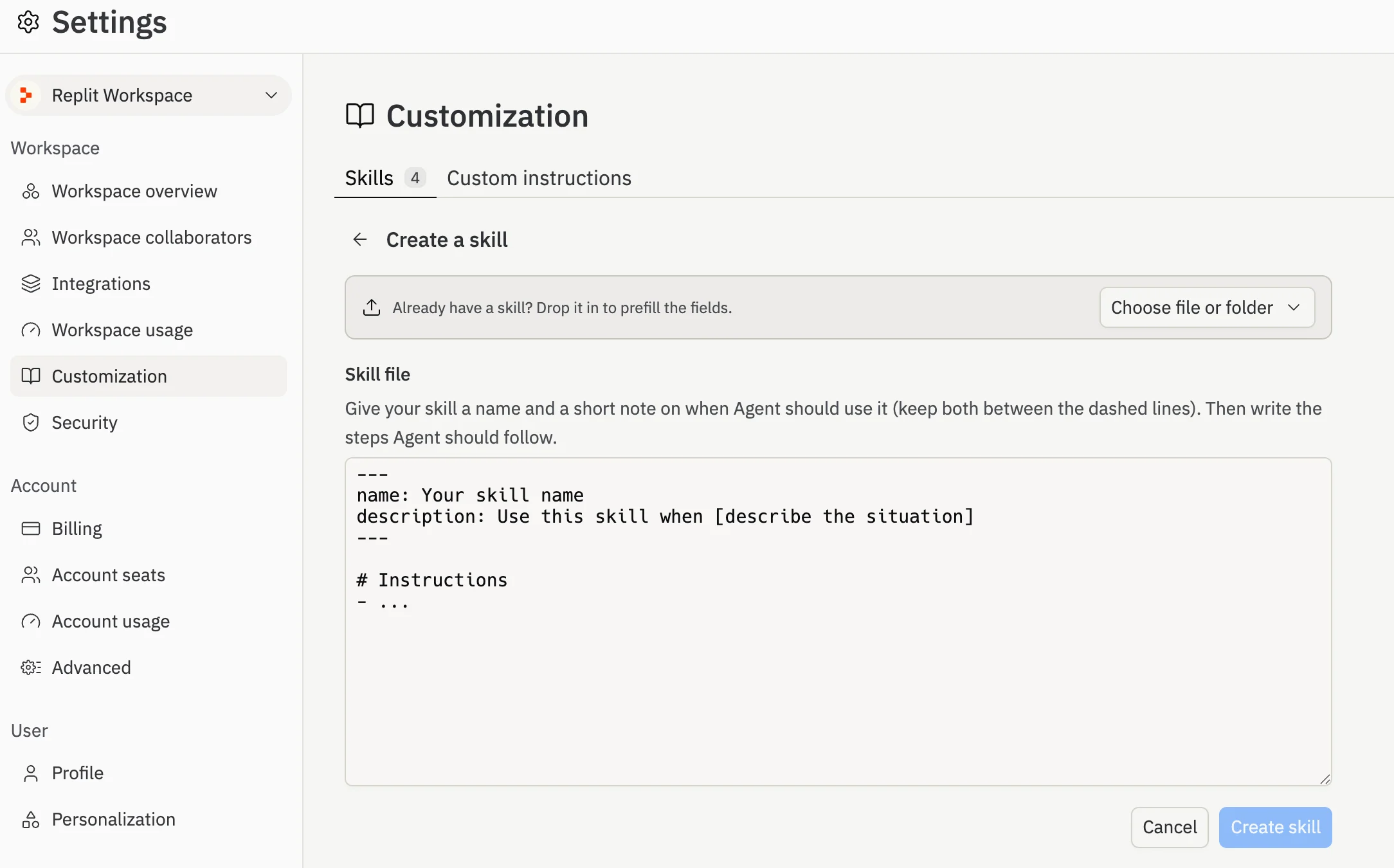
With your components ready, the final step is to create a design system skill so Agent can reference your components, tokens, and usage patterns in every project. Copy the entire prompt below and paste it into Agent. Replace <your-design-system-name> with the name of your design system:
Create a `<your-design-system-name>` design system skill from the components and packages in this project.

Use the file structure shown below with a `SKILL.md` at the root, a `references/` directory for guides and component docs, and a `packages/` directory containing all dependencies needed to function.

Go through every component in the project and document each one in its own file under `references/components/`, including its props, variants, and example usage.

Format `SKILL.md` as an index that links out to the guide and component reference files, with a "General Guidance" section and a "Components" section, following the example shown below.

File structure:

.agents/skills/your-design-system/
├── SKILL.md
├── references/
│   ├── guides/
│   │   ├── setup.md
│   │   ├── guardrails.md
│   │   ├── layout-and-spacing.md
│   │   └── ...
│   └── components/
│       ├── component-index.md
│       ├── button.md
│       ├── checkbox.md
│       └── ...
└── packages/
    └── (Tar files or code components)

The `SKILL.md` file acts as an index that links out to separate markdown files for guides and component references. Each linked file covers one topic in detail. Here is an example of what the generated `SKILL.md` looks like:

```markdown
---
name: your-design-system
description: Use when building or modifying any UI. Provides component API references, layout guidance, and visual style rules for your design system.
---

# Your Design System

## General Guidance

- [Setup](references/guides/setup.md) — Installation, project configuration, and provider setup
- [Guardrails](references/guides/guardrails.md) — Hard rules that must never be broken (banned patterns, required tokens, accessibility minimums)
- [Layout & Spacing](references/guides/layout-and-spacing.md) — Grid system, spacing scale, responsive breakpoints, and page templates
- ...

## Components

- [Component Index](references/components/component-index.md) — Full list of available components with status and category

Individual component references (props, variants, examples):

- [Button](references/components/button.md)
- [Checkbox](references/components/checkbox.md)
- ...
```

Guide files cover one topic each — setup and installation steps, best practices and rules, reference tables for token values, and short code examples showing correct usage.

Component files document a single component each, including the component name, a brief description, a props table, usage examples, and any guidelines or constraints. The more complete these files are, the better Agent's output will be.

Connect your skill to Agent

Once the skill is created, make sure your custom_instruction/instructions.md points Agent to it:
# Design System

Read and follow the design system skill at `.agents/skills/your-design-system/`.
Always apply the design system when building or modifying UI.
Finally, pre-populate replit.md with design-system-specific context so Agent understands your visual standards from the start. Include a project overview, your preferred component library, key design preferences (spacing scale, accessibility requirements), and the architecture stack.

Validate your setup

Before rolling out your design system, verify these essentials:
  • custom_instruction/instructions.md points Agent to your design system skill
  • .agents/skills/ includes the skill with component references, guides, and packages
  • replit.md is pre-populated with project overview, preferences, and architecture
  • Design tokens file is included (tokens.css or equivalent)
  • Design system package is pre-installed in package.json
  • Create a new test app and verify Agent uses the design system correctly

Pin the design system to your organization

Once your design system is ready, pin it so every org member can use it:
  1. Navigate to the design system app in your organization
  2. Open the app’s action menu (three-dot menu)
  3. Select Pin to Agent input box
App action menu showing the Pin to Agent input box option
Only org admins (members of the system_admins role) can pin and unpin design systems.
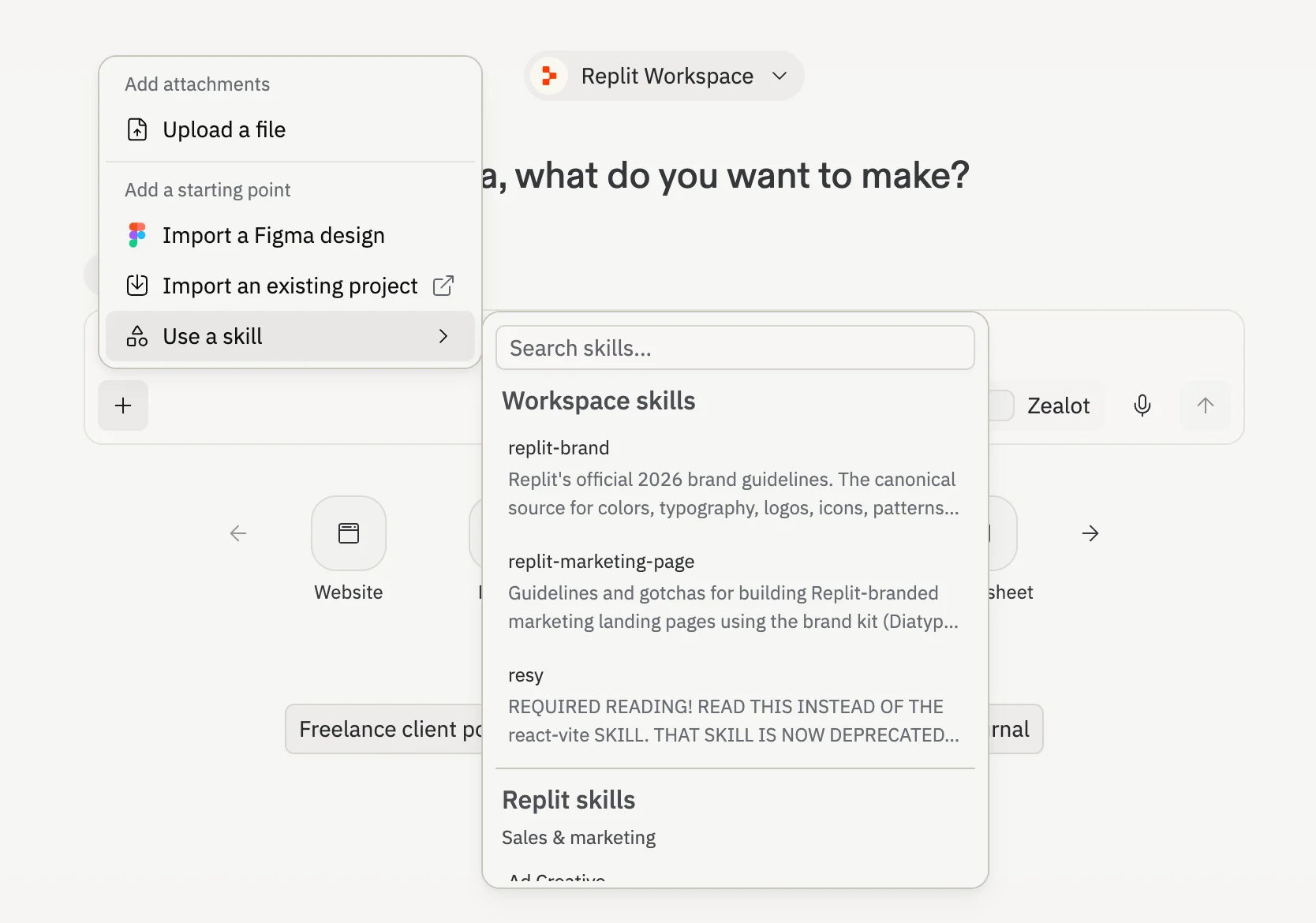
Set member access to Read-only so that members can see and use the pinned design system without being able to edit it. Invite dialog showing member access set to Read-only The design system now appears as a selectable pill below the Agent input box for every member of your organization. To remove it, open the same menu and select Unpin from Agent input box. Design system appearing as a selectable pill in the Agent input box

Maintain your design system over time

Design systems evolve. Keep yours current:
  • Update token files when your design system ships new colors, spacing, or typography values
  • Update skills when components get new props, variants, or usage patterns
  • Update instructions when design principles or standards change
  • Bump package versions when new releases of your design system ship
  • Test regularly by creating a new app and verifying that Agent produces correct output

Design Systems vs. Custom Templates

Design systems and custom templates serve different purposes:
Design SystemsCustom Templates
PurposeChange the frontend stack to your team’s and utilize your code componentsReplace the default stack entirely (e.g., Rust, Go, C++)
StackWorks within the standard Replit pnpm monorepoDefines a completely custom project structure
What it providesComponent library rules, design tokens, brand assets, visual skillsFull boilerplate: runtime, build config, dependencies, project layout
Applies toWeb apps, mobile apps, slides, artifacts - anything Agent buildsOnly apps created from that specific template
Use a design system when you want Agent to follow your visual standards across the normal Replit experience. Use a custom template when you need a fundamentally different stack.